




You know that feeling when we’re steadily losing weight, seeing progress on our weight loss journey week after week of consistent effort, and then suddenly… BAM! The scale stops budging. This is what we call a weight loss plateau. As a fully qualified personal trainer and nutritionist, I often talk to women who are going through a weight loss plateau. I’ve also gone through a weight loss plateau a couple of times when I was younger and didn’t know how to prevent it.
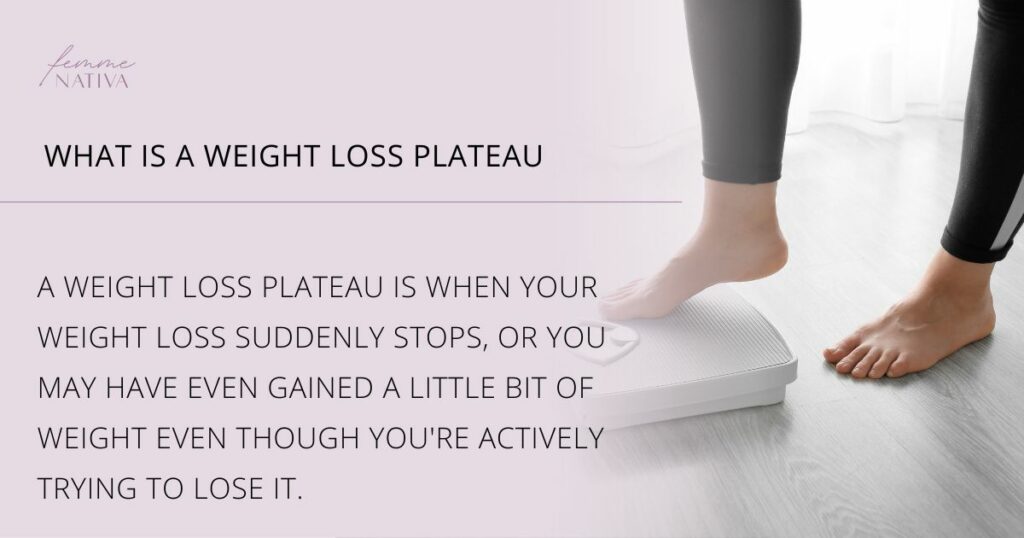
A weight loss plateau is when your weight loss suddenly stops, or you may have even gained a little bit of weight even though you’re actively trying to lose it. Before I continue and give you my best advice on how to break through a weight loss plateau, please know that no healthy, sustainable weight loss goes in a straight line, it has its ups and downs.
This is why I’m also going to share with you some common signs of weight loss plateau and tips on how to prevent them in the first place.
WHAT IS A WEIGHT LOSS PLATEAU?
A weight loss plateau refers to a period during your weight loss journey where progress stalls, this is when your weight stops changing. Picture this: you’ve been diligently watching what you eat, hitting the gym regularly, and the numbers on the scale have been steadily dropping. Then suddenly, it’s like hitting a brick wall – your weight just won’t budge anymore. Basically, when your weight stops changing even though you’re doing everything right, you can say you’ve hit a weight loss plateau.
You might wonder what’s going on, “why can’t I lose weight, what am I doing wrong”, especially when you’re eating healthy, staying at a calorie deficit and exercising regularly.
If this is happening to you, please know this is not your fault and it’s actually quite common. I’ve been through it and a lot of other women go through the same. You’re not alone.
WHY DO WEIGHT LOSS PLATEAUS HAPPEN?
Now, you might ask, “What gives? Is my body sabotaging my efforts?” Well, weight loss plateaus happen for a variety of reasons but I’m going to focus on 2 main ones – weight loss plateaus that happen during sustainable weight loss and plateaus that happen when you’re losing weight super quickly (probably unhealthily and in a non-sustainable way).
1. SET POINT THEORY – WEIGHT LOSS PLATEAU DURING SUSTAINABLE WEIGHT LOSS
Your body has a natural weight range, known as the Set Point Theory.
If you are losing weight at a healthy, sustainable weight, you may experience a stop in your weight loss after you reach a certain weight. Basically, your body gets to a certain weight and then just stops the weight loss. This is your body’s way of adjusting to its new normal and new lower weight.
Every person has their own ideal weight, and your body will stay around that weight when you are eating healthily and your body is in good general health, and by that I mean you don’t have any hormone issues, gut issues, etc.
The average person has a set point range of about 5-10% of their body weight. So that means if you weigh 65 kgs, you could lose 5-10% or 3 to 6.5 kilograms without too much trouble. However, going below this weight would be difficult, because your body is functioning at this set point and will do everything it can to maintain it.
This means your body may start sending you more hunger signals while trying to get you to maintain this weight. The “hunger hormone” known as ghrelin is higher in people who have lost weight. And higher ghrelin also signals to your body to store fat.
This type of weight loss plateau is also heavily related to the changes in your body composition that happen as you’re losing weight.
As you lose weight, you lose both fat and muscle mass. Muscle is more metabolically active than fat, meaning it burns more calories even at rest. So, as you shed pounds and lose muscle, your metabolism slows down, making it harder to continue losing weight. A lower metabolism naturally means your weight loss will stabilize or plateau because you’re burning fewer calories overall.
RELATED POST: HOW TO SPEED UP YOUR METABOLISM
2. WEIGHT LOSS PLATEAU DURING UNSUSTAINABLE WEIGHT LOSS
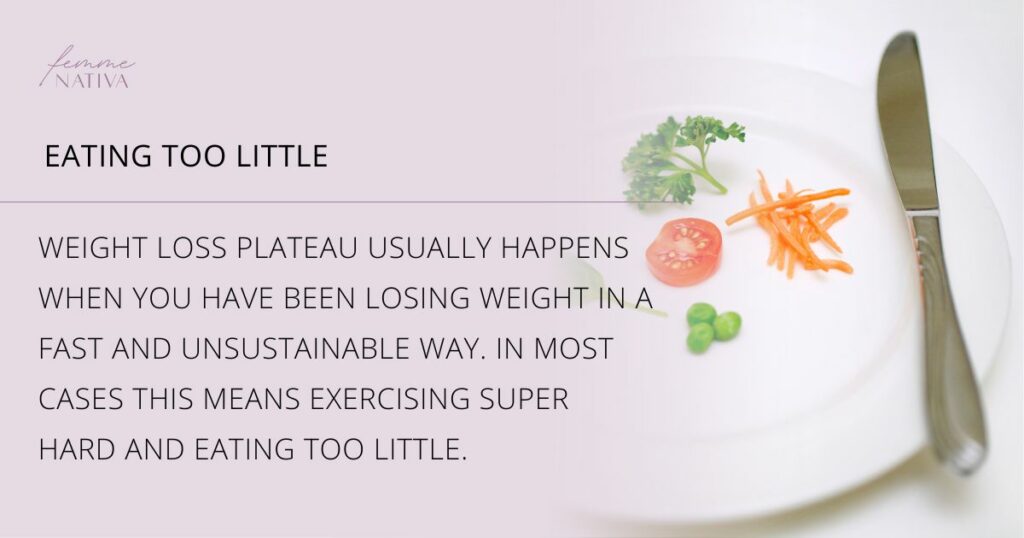
As I mentioned, there are 2 reasons for a weight loss plateau. The first which I have just talked about is a natural plateau caused by your body readjusting to its new set point or new normal weight. The second type of weight loss plateau usually happens when you have been losing weight in a fast and unsustainable way. In most cases, this means exercising super hard and cutting your calories too much.
If this has happened, usually you will stop losing weight and it’s likely you’ll gain it all back because you can’t keep up the diet and exercise that you were doing to lose weight.
I often see women making this mistake. They try to lose weight fast and end up eating too little. I know because I’ve been there myself. In my early 20s, I thought I could lose weight quickly by severely limiting my calorie intake. And let me tell you, this was a BIG mistake. Let me explain.
Anytime you’re eating at a calorie deficit meaning you’re eating calories than you should eat to maintain weight, your metabolism slows down. The more you cut your calories, the more you’ll be slowing your metabolism down. And the slower your metabolism is, the harder it will be to lose weight.
RELATED POST: MISTAKES I’VE MADE AND WHAT I’VE LEARNED ON MY FITNESS JOURNEY
SIGNS YOU’VE HIT A WEIGHT LOSS PLATEAU
Here are some of the most common signs I’ve seen of a weight loss plateau. I’ve also experienced most of these while being stuck in a weight loss plateau. :/
STALLED WEIGHT LOSS
If you’ve been steadily losing weight and suddenly notice that the scale hasn’t budged for several weeks despite maintaining your diet and exercise routine, you may have hit a plateau. This is pretty much the most obvious sign.
YOUR MEASUREMENTS ARE NOT CHANGING
Even if your weight remains the same, when you change your diet and workout routine you might expect to see changes in other measurements like waist circumference or body fat percentage during weight loss. If these measurements also remain the same over time, you’ve most likely hit the plateau. I actually prefer to take my measurements than to weigh myself. I just find this method to be more accurate in showing progress and I highly recommend it to all my clients.
LACK OF ENERGY OR MOTIVATION
Feeling fatigued, unmotivated, or disheartened despite sticking to your diet and exercise plan can be a sign of a plateau. Plateaus can take a HUGE toll on your emotional well-being and oftentimes lead to frustration or disappointment.
NO PROGRESS IN FITNESS GOALS
If you’ve been exercising regularly and notice that your fitness level has plateaued or you’re not seeing improvements in strength, endurance, or performance, your body may hit a plateau.
CONSTANTLY FEELING HUNGRY OR HAVING INTENSE CRAVINGS
During a plateau you may experience increased hunger or cravings that seem difficult to manage. When you start eating at a slight calorie deficit, it’s normal to feel somewhat hunger. But if you are constantly feeling hungry this could be a sign that your body is resisting further weight loss. Or, this could mean that you’re not eating enough fiber and/or protein. I would highly recommend making sure you’re eating enough fiber and protein, especially when being at a calorie deficit. Both protein and fiber will help you feel fuller for longer.
RELATED POST: WHY YOU NEED PROTEIN FOR FAT LOSS
INCONSISTENT PROGRESS OVER TIME
Plateaus often occur after an initial period of rapid weight loss, especially if you’ve been cutting your calories too much. If you’ve experienced significant progress in the past but are now struggling to continue, it may be a sign of a plateau.
HOW LONG DOES A WEIGHT LOSS PLATEAU LAST
If you’re losing weight the sustainable way, then a weight loss plateau may last 8-12 weeks, or 2-3 months, which is quite a long time. So it’s really important not to give up and go back to your old ways. Don’t let this 2-3 month period of a weight loss plateau discourage you. Your body is just doing what it needs to do.
If you have been losing weight in an unsustainable way (eating too little, exercising too hard) or some of your lifestyle factors are getting in the way, then the weight loss plateau will last as long as you continue on this same path. So I would highly encourage you to strive for slower weight loss, and make some healthy changes along the way that you can continue with forever.
HOW TO BREAK THROUGH A WEIGHT LOSS PLATEAU – ADVICE FROM A FULLY QUALIFIED PERSONAL TRAINER
So you’re losing weight in a healthy and sustainable way, you’ve been through a plateau, or your body’s way of adjusting to a new normal, now what? How do you start losing weight again? Technically, there are only 2 things you need to do – build muscle and re-calculate your ideal calorie intake (based on your new weight).
INCREASE YOUR METABOLISM – BUILD MORE MUSCLE
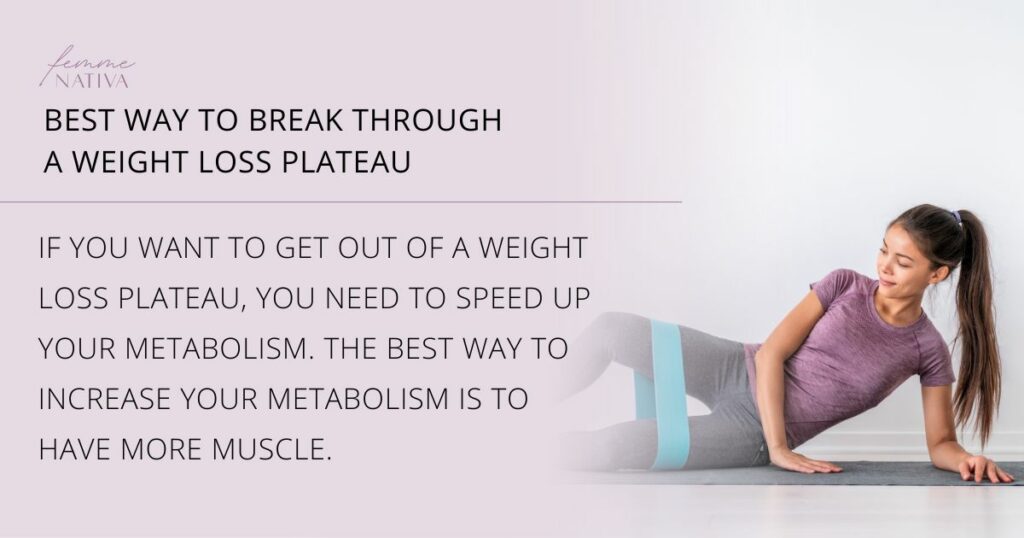
If you want to get out of a weight loss plateau, you need to speed up your metabolism. The best way to increase your metabolism is to have more muscle. This will not only help you reduce body fat, but you’ll be able to eat more calories and still be able to lose weight. When you lose weight, you’ll also lose both fat and muscle. So it’s important to continue to focus on building muscle.
To build more muscle, you don’t need to lift heavy weights if you don’t want to. The heavier you lift, the more muscle you will build. But you don’t need to pack on lots of muscle to have a healthy, lean and toned body and increase your metabolism. Body weight exercises, like the ones you can find in my programs, will be more than enough.
ADJUST YOUR DIET FOR WEIGHT LOSS
When it comes to diet, if you have lost weight, you’ll need to re-calculate your ideal calorie intake. You can use my calories and macros calculator to figure out your ideal calorie intake and how many calories you should be eating for sustanable weight loss. To calculate your ideal calorie intake, please follow this link or click the button below.
So once you know how many calories you need to eat for a sustainable weight loss, I would recommend tracking calories for a few days or a week just to make sure you’re actually eating that amount. The easiest way to track calories is to use the free app called My Fitness Pal. And be sure to focus on eating enough protein and fiber. As I mentioned, this will help will feel fuller for longer.
If you follow these 2 tips – building muscle and reassessing your ideal calorie intake and you are struggling to lose weight after a plateau, then there is a possibility that your body is reaching its ideal weight. Once it reaches this weight, it will be really hard to lose more than this. So maybe what you think is a plateau is just your body reaching its ideal weight. So make sure that your weight loss goal is realistic.


SUMMARY
If you want to break through a weight loss plateau, these are my 2 best tips. If you follow them, you should get out of a weight loss plateau in 2-3 months.
Build muscle to help increase your metabolism. But remember you don’t need to build huge amounts of muscle to have a healthy, lean and toned body and a healthy metabolism.
Re-calculate how many calories you need now that you are at a lower weight. Track calories for a few days or a week to make sure you are eating the right amount. And prioritize protein, and fiber.
If need help in achieving weight loss goals and avoiding plateaus, I would highly recommending exploring our Femme Nativa App! You can also download it for on App Store or Google Play and access some free challenges and meal plans we have there. :)
The app contains all our programs that you can purchase separately or in a bundle. Our programs target different areas of the body that many women find difficult to slim and tone. All of the programs include full-length videos guided by a trainer so you can easily follow along. The best part is that you can do these workouts from the comfort of your own home whenever you can find the time.
I cannot wait to see you there!
Love Rachael Xx

SOURCES:
- Weight Loss Plateau – https://www.ncbi.nlm.nih.gov/books/NBK576400/
- Set Point Theory – https://www.ncbi.nlm.nih.gov/books/NBK592402/
- Muscle More Metabolically Active than Fat – https://www.mayoclinic.org/healthy-lifestyle/weight-loss/in-depth/metabolism/art-20046508






 It’s FREE