



Are you spending hours in the gym every week and not seeing the results you want? Are you constantly feeling tired or fatigued when you train? Do you want to stay healthy and look great as you’re getting older but don’t know how to do it without exhausting yourself?
If you answered YES any of these questions, please keep on reading.
WHY I RECOMMEND LOW IMPACT WORKOUTS FOR WOMEN
As a certified PT and a 35 y/o woman who has tried every type of training out there, I know exactly how it feels to spend hours in the gym and do tons of HIIT without getting the results you want. I also know how it feels to constantly feel tired and drained from your workouts when you’re supposed to feel great and energised.
And as I get older, I also want to make sure I’m prioritising my health. I’m doing everything I can to stay active and healthy while also maintaining my physique.
So what are we women supposed to do if we want to feel good both on the inside and on the outside without having to spend hours in the gym? How should we train?
For me, the answer to this is focusing on mostly low impact workouts. I’m a huge advocate for low impact workouts. I’m going to share with you all of my favorite low impact workouts plus their pros and cons.
Since a lot of women in their 30s and 40s are asking me about bone health and low impact resistance training, I’m also going to share scientific studies and trusted medical sources I found on this topic for every type of low impact training mentioned in this blog. Contrary to the popular belief in the fitness community, heavy weight lifting is not the only thing you can do for your bone health. :)
Even if you realise doing mainly low-impact workouts may not be the best option for you, I hope this blog post, helps you make the right choice for yourself. :)
WHAT IS LOW IMPACT TRAINING?
Low impact training is any form of exercise that is gentler on your joints and that puts less stress on your body in general (doesn’t increase your cortisol – stress hormone levels). Since low impact exercises are generally easier on the body this makes them a great option for women of various fitness levels and ages.
I also recommend this type of training to women who prefer a leaner and slimmer look without any unwanted bulkiness.
WHO SHOULD DO LOW IMPACT WORKOUTS?
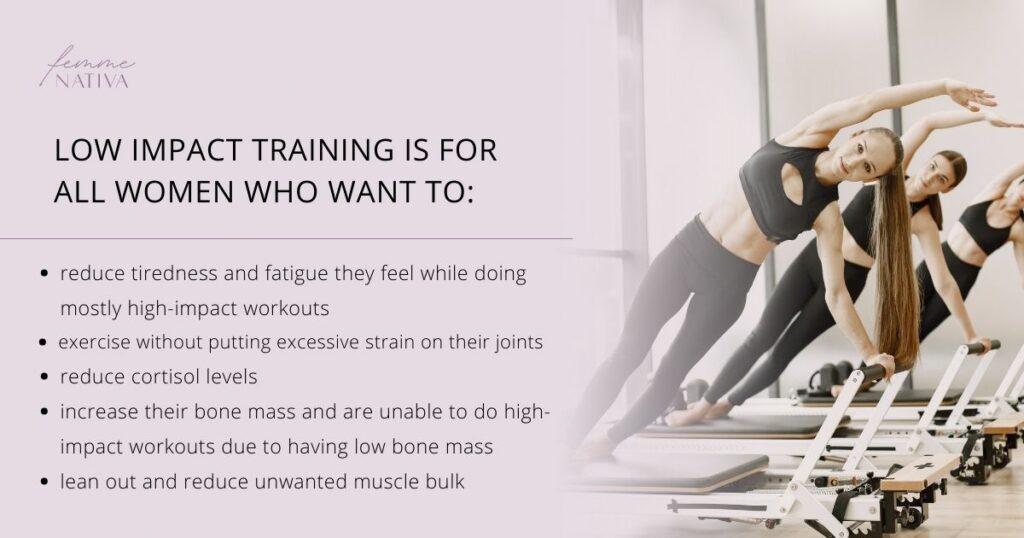
Low impact training is a great option for women looking to:
- reduce tiredness and fatigue they feel while doing mostly high-impact workouts (heavy weight lifting, running, HIIT, etc.) – this is 100% me!
- exercise without putting excessive strain on their joints
- reduce cortisol levels (cortisol is a hormone that raises when we are under stress) – again, 100% me!
- increase their bone mass and are unable to do high-impact workouts due to having low bone mass
- lean out and reduce unwanted muscle bulk – a lot of women prefer a leaner and slimmer look, myself included
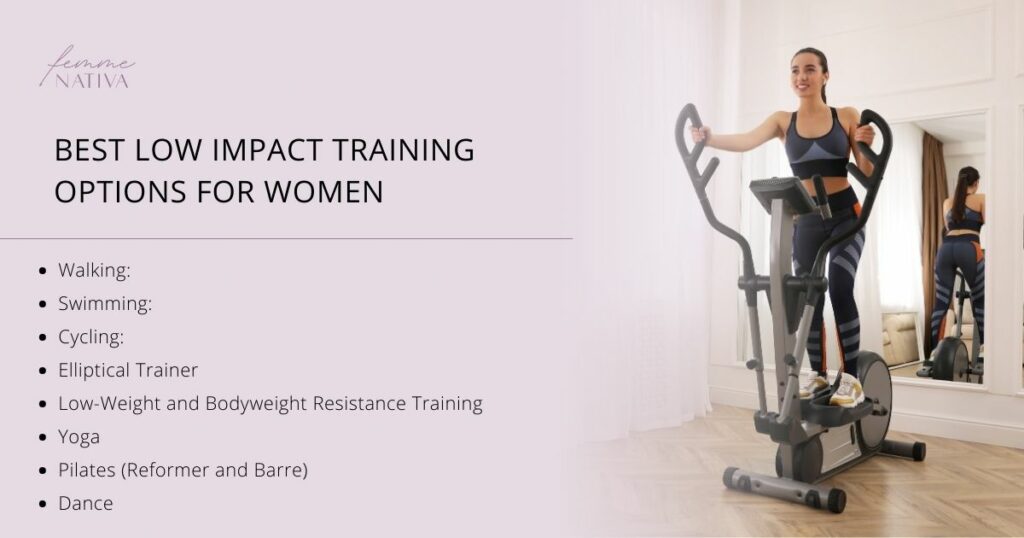
WHAT ARE THE BEST LOW IMPACT TRAINING OPTIONS FOR WOMEN?
This will depend on your goals but in general, I’d recommend choosing at least 1 cardio (like walking or elliptical) and 1 resistance training option (pilates or similar bodyweight resistance training). Any good, well-rounded program should have both cardio and resistance training.
Below are some of my favorite low impact exercises I recommend to my clients:
Walking:
Walking is one of the simplest low impact cardio exercises that almost anyone can it. It is also a so-called weight-bearing exercise which means it helps build bone mass. It can be done It’s easy to incorporate into your daily routine, whether it’s a brisk walk around the neighborhood or a stroll in the park.
Also, walking actually burns fat. Yes, you’ll have to do a lot of walking for it to be effective but still, it will help you lose extra body fat. For best results, I recommend if you combining it with a slight calorie deficit and some form of resistance training. I prefer low impact, pilates style resistance training. If you want to learn more about how walking can help you lose extra body fat, please read this blog post on why you need cardio for fat loss.
Another thing why I love walking is the fact that it doesn’t increase your cortisol levels (stress hormone). As a matter of fact, this study and this study show that low impact workouts, like walking, may actually help reduce cortisol. (Unlike high-intensity workouts that increase your cortisol levels).
The only downside of walking I could find is that you need to do quite a lot of walking for optimal results. I recommend around 7.000-10.000 steps per day.
RELATED POST: WALKING OR RUNNING – WHICH IS BETTER FOR FAT LOSS
Swimming:
Swimming and water aerobics are excellent low Impact options. For most of us who are recreational swimmers, swimming will be aerobic (low impact) workout. (Swimming can be both aerobic (low intensity) and anaerobic (high-intensity) workout.)
It is also a full-body resistance training workout. The buoyancy of the water reduces the impact on joints while providing resistance.
Swimming will most likely NOT help with bone-building though so be mindful of that. There is a new review/meta-analysis that claims there may be at least some bone-building benefits from swimming but most experts seem to agree swimming is not something that will help you reduce the risk of osteoporosis.
Swimming is a great option if you want to reduce stress on your joints and stress in general since, like walking, swimming also has a positive effect on cortisol levels. For example, in this study, scientists observed that cortisol levels after swimming were significantly lower when compared to cortisol levels after running.
RELATED POST: FAT BURNING ZONE – LEARN HOW TO BURE MORE FAT
Cycling:
Riding a stationary bike or cycling outdoors is gentle on the joints and can be adjusted to different intensity levels. It’s an effective cardiovascular exercise and it’s easier on your knees than high impact workouts like running or HIIT which has a lot of jumping.
There are however 2 downsides to cycling – one is strictly health-related and the other has more to the with our personal preferences.
OK, let’s go to the first, health-related downside. Studies have found that cyclists compared to other athletes, have lower bone density. So it seems that cycling may be making our bone health worse and not better.
If you are someone who wants to ensure better bone health or you know you’re at risk of osteoporosis, I would recommend sticking to walking, elliptical, or some other low impact aerobic type of training.
CYCLING AND KNOWING YOUR BODY TYPE
Let’s move to the other cycling downside. This is totally an aesthetic matter but still important to a lot of women. If you are someone who doesn’t want to build a lot of muscle in your legs (and what is a lot is subjective), you may want to avoid cycling more than twice per week if you have a mesomorph body type. If you have an endomorph body type and you feel like you build muscle super quickly, cycling may not be the best option for you.
I have a mesomorph body type and I noticed my legs getting bigger after adding cycling to my routine 3 times per week.
Knowing your body type will help you decide which workouts are better for you and your fitness goals so I would highly recommend learning your body type. All of my clients start by doing a quick, free body type quiz that helps them determine their body type. If you’d like to know yours, just follow this link or click the button below.

RELATED POST: WHY YOU NEED TO KNOW YOUR BODY TYPE
Elliptical Trainer:
The elliptical machine provides a smooth, low impact workout that engages both the upper and lower body. It’s a good alternative to running or walking. I always say to my clients – “If you don’t want to walk, elliptical is the next best thing”. Just be mindful of one thing. If one of your main goals is to fat in your lower body, walking just seems to be working better.
Elliptical is also a good option for women who want to improve their bone density and are not allowed/cannot do high-impact workouts.
If you are someone who has issues with high cortisol, the good news is that exercising on the elliptical trainer should NOT increase your cortisol levels as long as you’re exercising at an intensity that’s 60% or lower of your heart rate reserve.
Low Weight and Bodyweight Resistance Training:
Strength (resistance) training with light weights, resistance bands, or just your body weight is an effective way to build muscle without putting excessive strain on the joints. Research also shows that resistance training is important for preserving and improving bone health, especially in us women and especially as we are growing older.
I used to lift heavy weights and I loved how much stronger it made. But to be perfectly honest, I didn’t love the way it made me look. I just felt heavy weight lifting made me look too muscular for my liking.
If you are someone who builds muscle quickly (you have a Mesomorph or Endomorph body type) and you prefer a leaner and slimer look, heavy weight lifting may not be the best option. In this case, low impact, mostly bodyweight resistance training might be a better option.
I personally LOVE this type of training because it doesn’t leave me feeling exhausted AND it’s great for achieving that lean and toned look a lot of women want.
RELATED POST: HOW TO GET LEAN AND NOT BULKY – FEMALE GUIDE
Yoga:
Yoga is well known for its low-impact nature and flexibility benefits. There are various styles of yoga, so you can choose a class that suits your fitness level, goals, and preferences.
Some types of yoga, like Vinyasa, can help with muscle toning, especially for women who are new to resistance training. Many yoga poses require you to support and move your body weight, providing a form of resistance for various muscle groups, including the core, arms, shoulders, and legs.
Another great benefit of yoga is the fact that yoga may help with lowering cortisol levels. Plus, it’s been shown that yoga can have a positive impact on bone density.
So potentially, and especially if you are a beginner, yoga could be a good starting point for resistance training. But if I’m being perfectly honest, I would definitely add some other type of resistance training to your routine (Pilates or resistance training with light weights and resistance bands). Yoga alone probably won’t be enough to make you significantly stronger.
Pilates (Reformer and Barre):
Pilates focuses on core strength, flexibility, and stability. A lot of the moves can be modified to reduce impact while still providing a challenging resistance training workout.
I LOVE reformer Pilates and I never felt like it was interfering with my fitness goals. But I have had some women I trained tell me that they have bulked up from reformer pilates. Most of these clients had an Endomorph body type and their pilates trainers would include a lot of lunge and squat variations.
Barre classes can be great. But this depends a lot on your teacher and the style of barre they do. I have been to a barre class which included a ton of squat jumps, squat holds, and burpees. This type of barre could make your legs bigger and bulkier. If this is not something you want, I would try regular floor-based pilates instead.
When it comes to the relationship between Pilates and bone health, there are indications that Pilates can increase bone density in postmenopausal women who have osteoporosis.
Dance:
I love dancing and I often get asked if dancing is a good form of exercise. This depends of your goals and type of dancing you do.
Low-impact dance classes, such as ballroom or dance aerobics, can be a fun way to stay active without stressing the joints. Low impact dancing is also beneficial for bone health and it’s not going to leave you feeling exhausted.
Ballet, zumba and other dance styles that include a lot of jumping are high-impact. They are good for strengthening your bones but intense on the joints. Also, high imapct dancing can cause bulkiness in some body types so be mindful of that if one of your goals is slimmer thighs. High-impact dancing is also more likely to increase cortisol levels.
LOW IMPACT TRAINING FOR WOMEN FINAL THOUGHTS
OK, so the main question is – should you focus on low impact workouts, will these be enough for you?
Low impact workouts are a great option for women who:
- have hormone issues that can be made worse by high-impact workouts
- bulk up easily but prefer a leaner and slimmer look (this is highly subjective of course)
- have joint issues
- cannot high impact workouts due to health issues, injuries
Whether low impact workouts are for you largely depends on your:
- personal preferences
- fitness and health goals
- lifestyle
- abilities
If you prefer high impact workouts like running or heavy weight lifting and you don’t feel any negative effects, that’s great! You just keep doing what works best for you. I’m hear to support you. :)
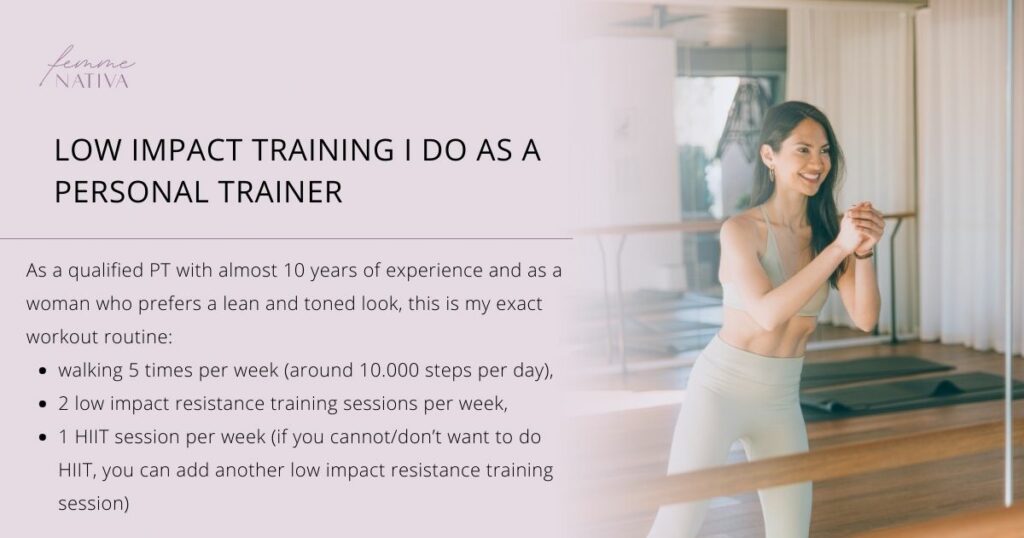
And if you enjoy low impact workouts, I promise it’s totally fine to focus mostly on low impact cardio and resistance training. I do mostly bodyweight resistance training and walking as my cardio. Once a week I do a HIIT workout (high-intensity interval training) annd that’s it! And I can honestly tell you I’ve never felt better in my life!
This routine I created for myself years ago, I also transferred into my fitness programs. So if you are looking a low impact but high result fitness program and you prefer a lean and toned look, my programs would be a great option for you. You can check them out below. :)
Love Rachael

SOURCES:
- Low Impact Weight Bearing Exercises – https://www.ncbi.nlm.nih.gov/pmc/articles/PMC3296386/
- Walking Reduces Cortisol Levels – https://www.ncbi.nlm.nih.gov/pmc/articles/PMC6920124/, https://pubmed.ncbi.nlm.nih.gov/18787373/
- Swimming for Bone Building – https://www.ncbi.nlm.nih.gov/pmc/articles/PMC7245678/
- Swimming VS Running – Cortisol Levels – https://pubmed.ncbi.nlm.nih.gov/29281146/
- Cycling and Bone Density – https://www.ncbi.nlm.nih.gov/pmc/articles/PMC3230645/
- Resistance Training and Bone Health – https://www.ncbi.nlm.nih.gov/pmc/articles/PMC6279907/
- Yoga and Cortisol Levels – https://www.ncbi.nlm.nih.gov/pmc/articles/PMC3768222/
- Yoga and Bone Health – https://pubmed.ncbi.nlm.nih.gov/8884416/
- Pilates and Bone Health – https://pubmed.ncbi.nlm.nih.gov/26406222/
- Low Impact Dancing and Bone Health – https://pubmed.ncbi.nlm.nih.gov/34224342/
- High Impact Dancing and Cortisol Levels – https://link.springer.com/article/10.1007/s10465-022-09368-z



 It’s FREE
2 Responses
Hello!
I would like to know if we can combine two programs at the same time.
For example, I was thinking about the leg one and the butt one.
It would be advisable to do the exercises on alternate days or the exercises of each program on the same day.
I speak Spanish and use a translator.
Thanks and greetings
Hi lovely, thanks for reaching out! We highly recommend following one program at a time to avoid overtraining as this may cause bulking <3 Hope this helps xx